Resolved stellar disk
Cell-by-cell integration with center-to-limb variation, stellar rotation, Rossiter–McLaughlin geometry and configurable active regions.
Research software

Controlled simulations of stellar activity and planetary atmospheric signals in exoplanet transmission spectroscopy.
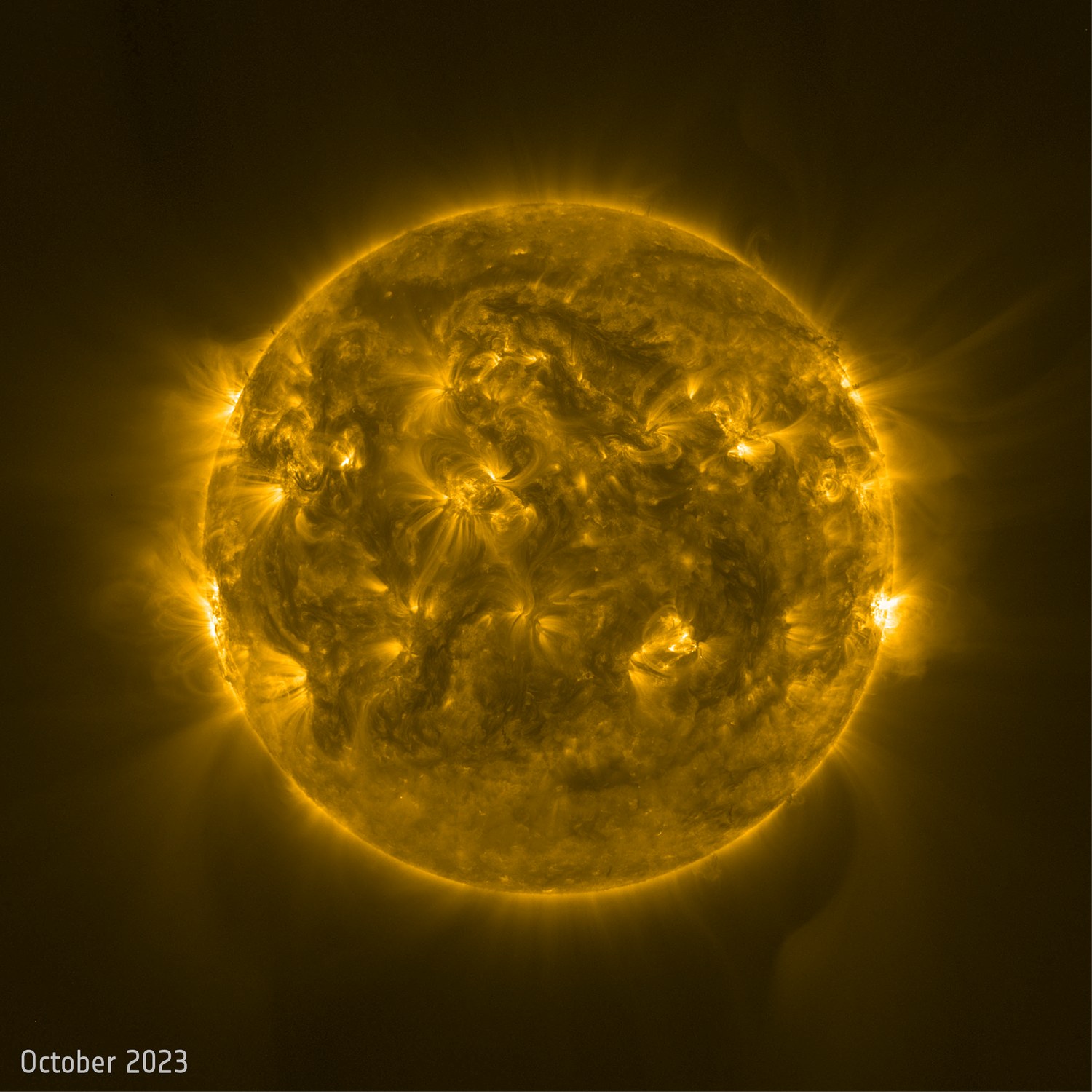
Can a cool starspot produce a spectral signal that resembles absorption by a planetary atmosphere? Starspot creates controlled experiments in which the physical origin of every signal is known.
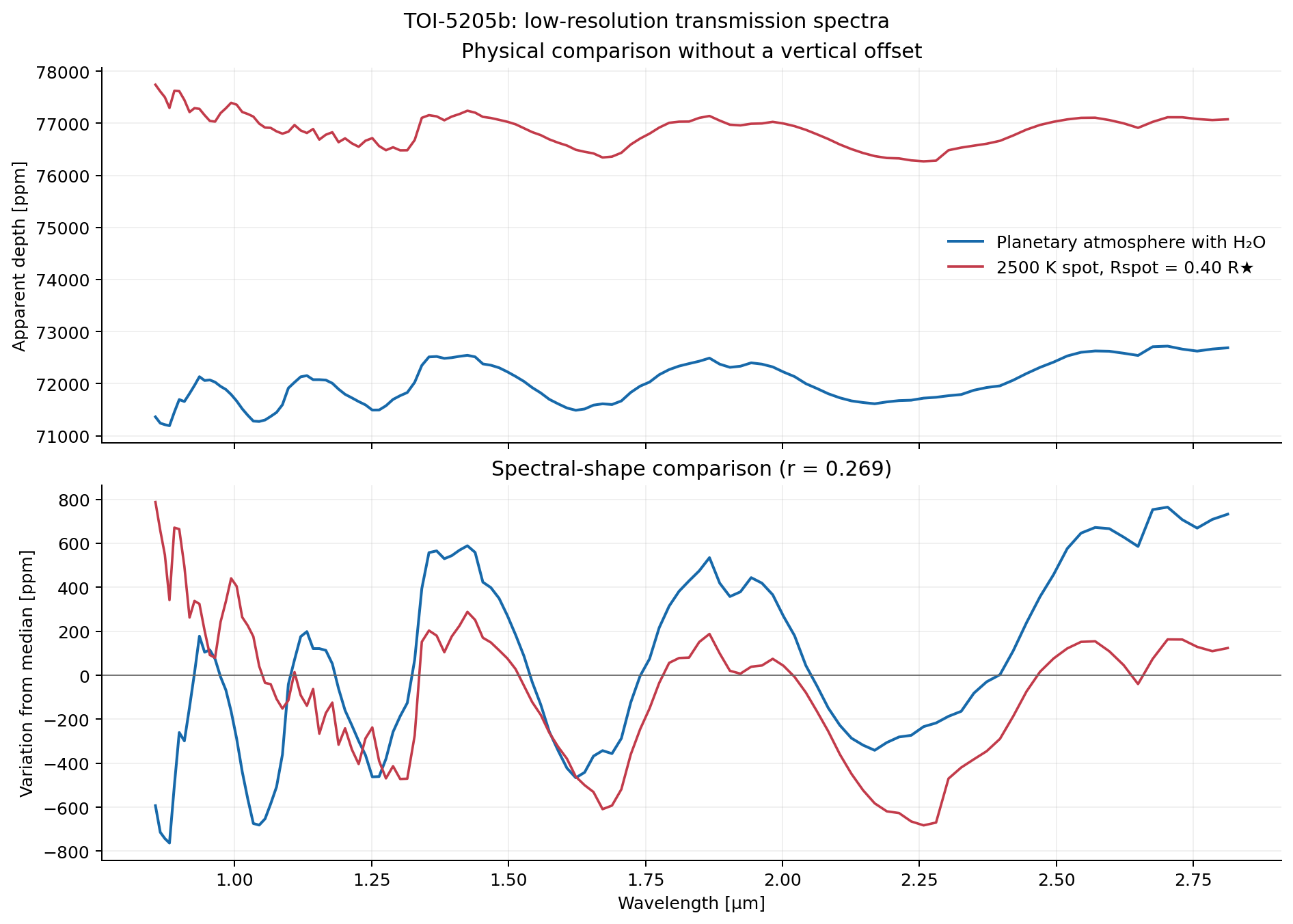
Two isolated scenarios are compared under the same conditions: a planet with an H2O atmosphere transiting a homogeneous star, and a constant-radius planet transiting a star with an unocculted 2500 K spot.
Simulation framework
Starspot generates time-resolved synthetic spectra from a defined physical configuration, preserving every input and output needed to reproduce a run.
Cell-by-cell integration with center-to-limb variation, stellar rotation, Rossiter–McLaughlin geometry and configurable active regions.
PHOENIX photosphere and spot models, wavelength-dependent planetary radius, molecular templates and instrumental resolution.
VIS/NIR spectral orders, controlled noise regimes, cross-correlation functions and stellar- versus planetary-frame diagnostics.
Spectral comparison
At low resolution, the atmospheric and stellar scenarios share broad regions of variation but are not equivalent. After removing their median levels, their spectral shapes have a Pearson correlation of r = 0.269.
Doppler kinematics
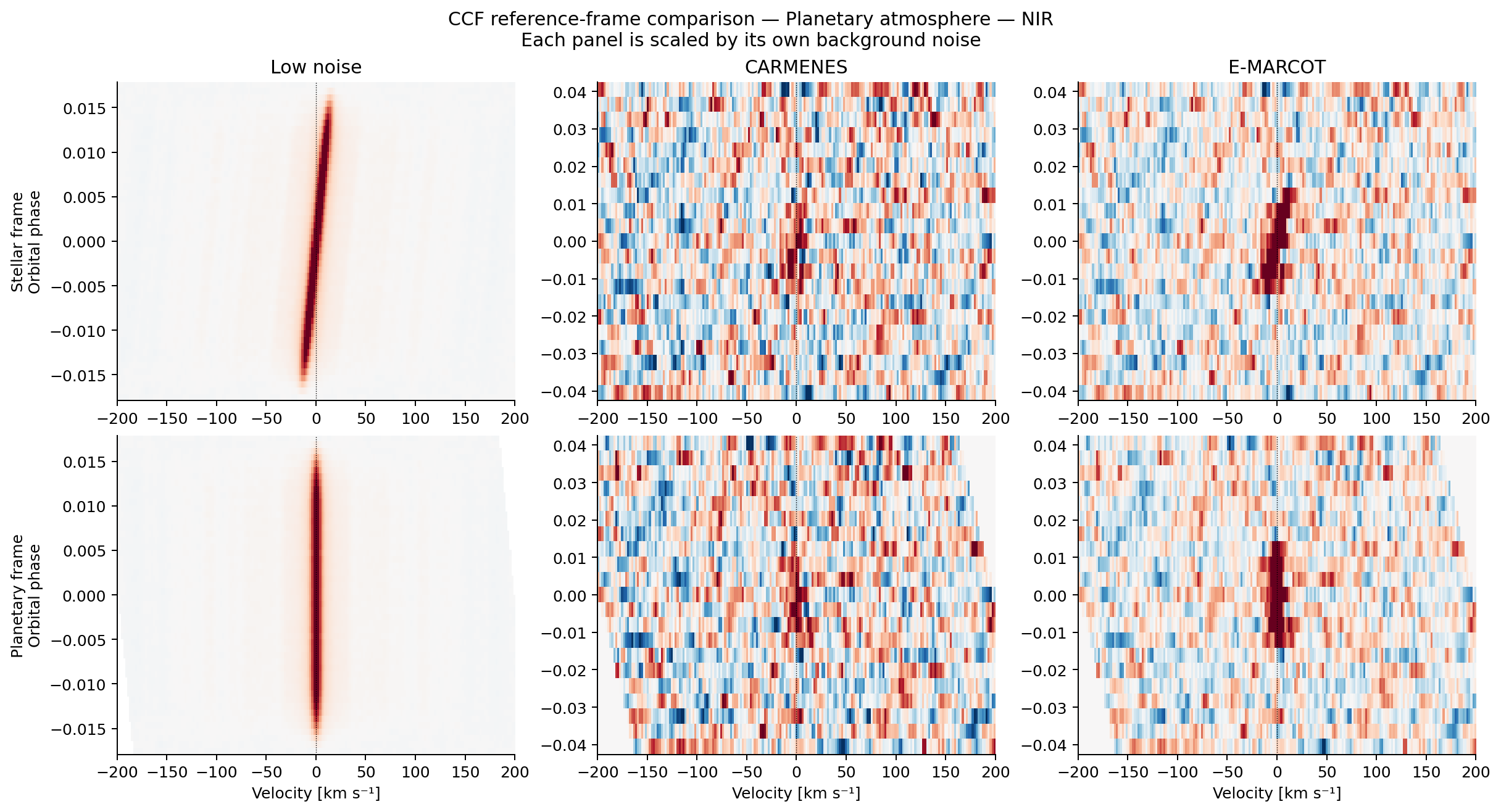
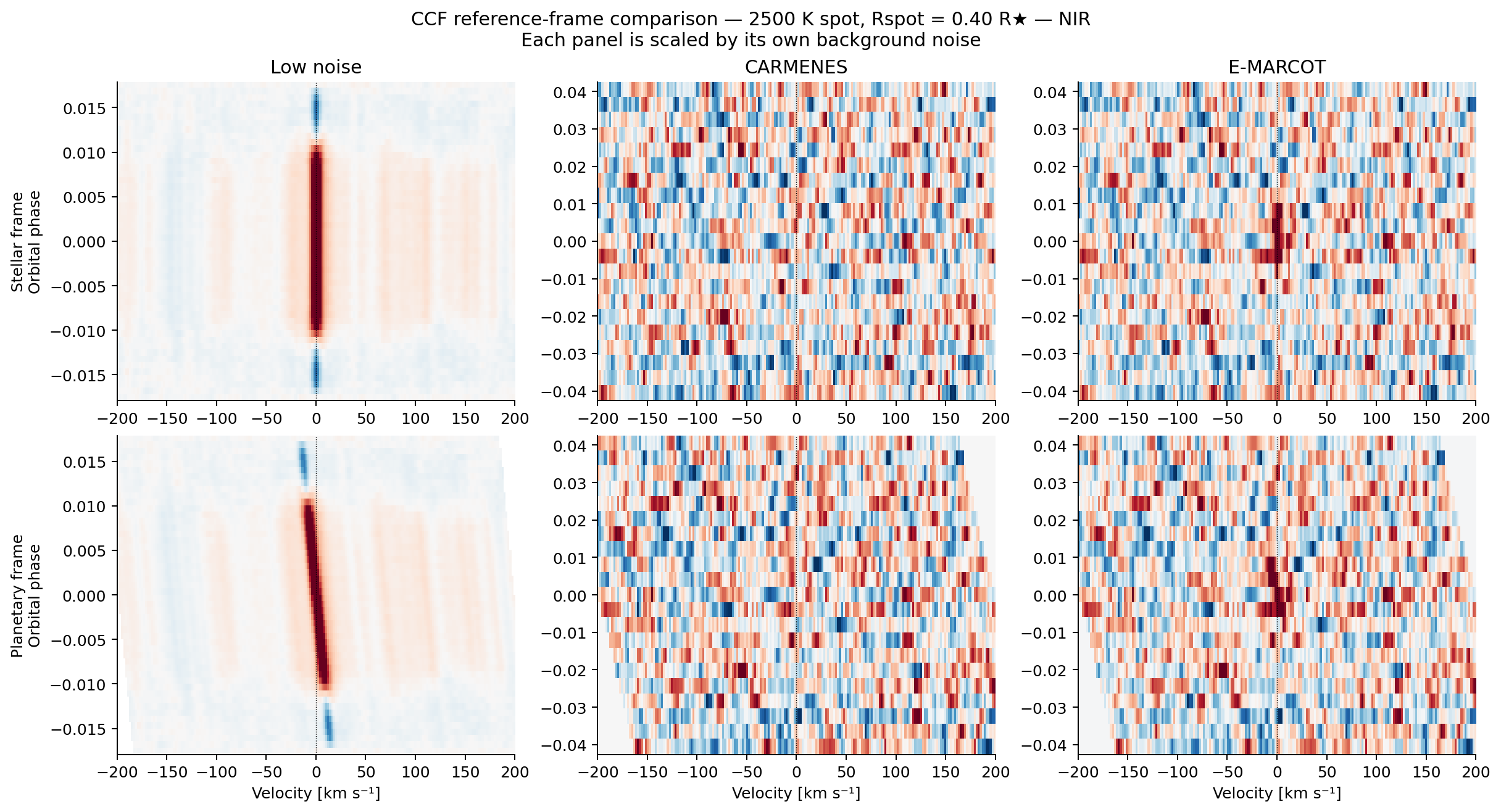
The planetary atmosphere follows the orbital velocity and becomes centered near 0 km s−1 in the planetary frame. Starspot contamination remains tied to the star and acquires the opposite trajectory after the same transformation.
Current results
The diagnostic below measures peak contrast relative to the CCF background. It is a comparative recovery metric, not a formal statistical significance.
| Scenario | Channel | CARMENES | E-MARCOT |
|---|---|---|---|
| Planetary atmosphere | VIS | 1.30 ± 0.72 | 3.64 ± 0.93 |
| Planetary atmosphere | NIR | 2.31 ± 1.08 | 6.79 ± 1.14 |
| 2500 K spot | VIS | 1.01 ± 0.53 | 0.98 ± 0.52 |
| 2500 K spot | NIR | 1.28 ± 0.62 | 3.10 ± 0.78 |
The different Doppler paths are recovered clearly.
One simulated transit does not recover a robust separation.
The adopted sensitivity scaling improves recovery, particularly for the planetary NIR signal.
A strong response to an H2O template measures spectral similarity; by itself, it does not establish a planetary origin or an atmospheric detection.
Starspot v6.1 is the documented internal research package used for this controlled study. It combines modular Python components, relative paths, bundled scientific inputs, tested workflows and traceable run configurations.
The current code package is available for selected academic review and scientific collaboration. It is not offered as a public download.
Starspot and the TOI-5205b case study were developed by Gerardo Mancebo as part of his Master’s thesis in Astronomy and Astrophysics, under the supervision of Dr. Giuseppe Morello.